
Why Is My Pool Losing Water? Common Causes and What to Do in Austin
Every pool loses some water. Evaporation, splash-out from swimming, and backwashing the filter are all normal parts of pool ownership. But when you find yourself adding water far more often than usual, or when the water level drops noticeably overnight, it’s time to figure out what’s actually happening.
Pool water loss is one of the most common concerns Austin homeowners bring to us, and the cause isn’t always a leak. Sometimes it’s evaporation running higher than expected in Austin’s summer heat. Sometimes it’s an equipment drip at the pad. Sometimes it is a structural or plumbing leak. Knowing how to tell the difference, and what to do in each case, can help you avoid unnecessary repairs and address real problems before they become more serious.
At Easy Pools, we’ve helped homeowners throughout the greater Austin area diagnose and resolve pool water loss for more than 15 years. The causes are often more predictable than most homeowners realize.
First: Is It a Leak or Just Evaporation?
Before assuming something is wrong, it’s worth understanding how much water loss is normal for an Austin pool. During the summer months, Austin pools can lose a significant amount of water to evaporation alone, especially during heat waves, low humidity stretches, or when a pool is heated. This is normal and expected.
A simple test can help you determine whether your water loss is within the range of normal evaporation or points to something that needs attention.
The Bucket Test
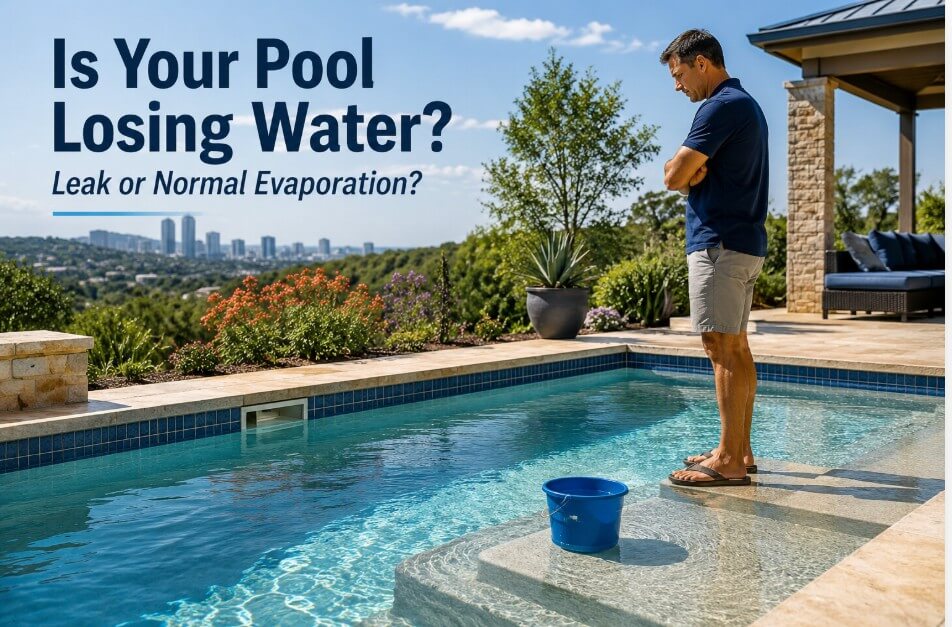
Fill a bucket with pool water and set it on a pool step so it’s partially submerged and exposed to the same sun and air as the pool. Mark the water level inside the bucket and the pool water level on the bucket’s exterior. Wait 24 hours without running the pool’s auto-fill system, then compare the two levels.
If the pool has lost significantly more water than the bucket, the difference points to a leak rather than evaporation. If both levels dropped by roughly the same amount, evaporation is the likely explanation and the amount of loss is probably within normal range for Austin’s climate.
Keep in mind that Austin’s summer heat can produce evaporation rates that surprise even experienced pool owners. During the hottest stretches, losing a quarter to half an inch of water per day to evaporation alone is not unusual. If you’re consistently losing more than that, the bucket test is a good first step before calling a professional.
Normal Causes of Pool Water Loss
Evaporation
Evaporation is the most common cause of pool water loss in Austin, particularly from late spring through early fall. High temperatures, low humidity, wind, and direct sun all accelerate evaporation. Heated pools evaporate faster than unheated ones.
Homeowners in Austin, Cedar Park, Lakeway, Georgetown, Round Rock, and Bee Cave often notice the highest evaporation rates during July and August when temperatures regularly exceed 100 degrees.
A pool cover significantly reduces evaporation when the pool isn’t in use, which is worth considering during the hottest months if water conservation is a priority.
Splash-Out
Active use, particularly with children or during parties, can account for meaningful water loss through splash-out. This is entirely normal and typically doesn’t require any action beyond routine top-off.
Backwashing
When a filter is backwashed to clean it, water is discharged in the process. Depending on how often your pool is backwashed and the size of your filter, this can account for a noticeable amount of water loss over time.
Common Causes of Pool Leaks in Austin
1. Shell Cracks and Structural Issues
The pool shell, whether gunite or concrete, can develop cracks over time. In Austin, the clay-heavy soil beneath many pools expands and contracts with moisture changes throughout the year. This ground movement puts ongoing stress on the pool shell and can eventually cause cracks, particularly around the floor, walls, or steps.
2. Plumbing Line Leaks
Pool plumbing runs underground between the pool shell and the equipment pad, and leaks in those buried lines are among the most difficult to detect without professional equipment.
Signs that may point to a plumbing leak include:
- Consistently low water pressure at returns
- The pump losing prime more frequently than normal
- Wet or unusually soft ground around the equipment pad
- Air bubbles appearing in return lines
- Higher than normal water bills
3. Skimmer Leaks
The skimmer is one of the most common leak points on an inground pool. Over time, the bond between the skimmer and the surrounding gunite or concrete can develop gaps.
A skimmer leak will often cause water loss that stops when the water level drops below the skimmer opening.
4. Return Fitting and Jet Leaks
The fittings where water returns to the pool can develop leaks where they connect to the shell. These leaks are often gradual but can account for meaningful water loss over time.
5. Pool Light Leaks
Underwater pool lights are set into a niche in the pool wall, and the conduit that runs from the light back through the pool shell can become a leak path if seals deteriorate.
6. Equipment and Valve Leaks
The equipment pad is another common source of water loss. Connections between pumps, filters, heaters, valves, and fittings can all develop leaks over time.
7. Spa and Water Feature Leaks
Pools with attached spas, waterfalls, fountains, or other water features have additional plumbing and structural connections that can become leak points.
Why Austin’s Soil Makes Water Loss More Urgent to Address
Austin’s expansive clay soil is highly reactive to moisture. This is especially relevant for homeowners in Austin, Cedar Park, Georgetown, Round Rock, and other Central Texas communities where this soil type is common.
When a pool leak introduces water into the surrounding soil on an ongoing basis, it causes the clay to expand. When the leak is repaired and the soil dries, it contracts. This repeated cycle can affect the pool structure, decking, hardscape, and even nearby foundations.
A slow leak that might be a manageable inconvenience elsewhere can contribute to more significant structural consequences in Austin’s clay-heavy ground.
What to Do If Your Pool Is Losing Water in Austin
Start with the bucket test. If the results point to a leak rather than normal evaporation, or if you’re observing any of the warning signs described above, the next step is professional leak detection.
Pool leak detection uses pressure testing, electronic listening equipment, and dye testing to locate the source of water loss without unnecessary excavation.
The most important thing is not to delay. Pool leaks do not resolve on their own and rarely stay the same size. A slow leak that’s manageable today often becomes more expensive and more damaging over time.
Frequently Asked Questions About Pool Water Loss in Austin
How much water loss is normal for an Austin pool?
Normal evaporation in Austin during summer can account for a quarter to half an inch of water loss per day, depending on heat, humidity, wind, and whether the pool is heated.
How do I know if my pool has a leak or is just evaporating?
The bucket test is the most reliable DIY method. If the pool loses significantly more water than the bucket, a leak is likely present.
Can pool water loss damage my yard or foundation?
Yes. Austin’s clay-heavy soil expands when wet and contracts when dry. Long-term leaks can affect surrounding hardscape, decking, and nearby structures.
What are the most common places pools lose water?
Common sources include skimmers, plumbing lines, shell cracks, pool lights, return fittings, equipment pads, and water features.
How is a pool leak detected professionally?
Professional leak detection uses pressure testing, electronic listening equipment, and dye testing to pinpoint the source.
Will a pool leak get worse if I wait to repair it?
In most cases, yes. Pool leaks rarely resolve themselves and often become larger over time as the underlying cause continues to deteriorate.
Can an auto-fill system hide a pool leak?
Yes. An automatic pool fill system can mask water loss because it continuously replaces the missing water. Many homeowners do not realize they have a leak until they notice unusually high water bills or perform a bucket test with the auto-fill turned off.
How much does pool leak repair cost in Austin?
Repair costs vary significantly depending on the source and severity of the leak. A professional inspection is the best way to determine the scope and cost of your specific repair.
Need Help Diagnosing Pool Water Loss in Austin? Easy Pools Can Help.
Easy Pools provides pool leak detection and repair services throughout Austin, Cedar Park, Lakeway, Bee Cave, Georgetown, Round Rock, and the surrounding communities.
We are an employee-owned company with a 97% customer retention rate, and proud members of Carecraft and the Pool and Hot Tub Alliance (PHTA).
Our team holds Certified Building Professional (CBP), Certified Service Professional (CSP), IPSSA, and Texas Pool and Spa Coalition (TPSC) certifications, and we are trained and certified to work with leading equipment brands including Jandy and Fluidra.
If you’ve noticed your pool losing more water than normal, or if the bucket test is pointing toward a leak, contact us to schedule a professional evaluation. The sooner the cause is identified and addressed, the less impact it has on your pool, your yard, and your water bill.
Contact Easy Pools to schedule an evaluation:
https://easypools.com/contact-us/